



FounderAWS Student Builder Groups
AWS Student Builder Group Leader
AWS Student Builder Group at Kookmin University
Sep 2026 – Sep 2027 · 12-month appointed term
AWS Student Builder Groups are Amazon Web Services' official student-led campus communities, the program students actually run themselves with AWS behind them. I founded the group at Kookmin University, bringing the program to the campus for the first time, and lead it on a 12-month appointed term.
What the group is
AWS Student Builder Groups (SBG) are the official global student community of Amazon Web Services: student-led, student-run groups on post-secondary campuses where members explore, build, and innovate with the AWS cloud. Membership is open to any student enrolled at a college or university who is 18 or older, with no prior AWS experience required, and the network now spans more than 1,000 groups across 68+ countries.
The program launched in 2023 as AWS Cloud Clubs and was renamed AWS Student Builder Groups to reflect what students were actually doing with it: less club, more hands-on building. Existing members kept their membership, badges, and progress through the transition, and the former Cloud Club Captains became Group Leaders.
A Student Builder Group is deliberately not a lecture series. It is run by students, for students: free hands-on workshops in real AWS accounts, certification study cohorts, build nights where members ship something small and working, project showcases, and career sessions with AWS engineers, solutions architects, and alumni. Because every group sits inside one global program, members also get access to AWS-run events and to builders in more than 1,000 other groups.
Korea has a real density of groups, and they work together. In July 2026, eight university groups (Seoul National, Kyung Hee, Kwangwoon, Dongduk, Dongguk, Konkuk, Inha, and Hanyang) jointly hosted the country's first AWS Student Community Day at the AWS Korea office in Seoul. Joining a group plugs a student into that national network, not just a campus club.
How the group runs
The group is built for students who want to leave with something working on their own AWS account. Certification cohorts run on a schedule toward Cloud Practitioner, labs move through EC2, S3, VPC, IAM, and CloudFront in members' own accounts, and build nights end with a deployed service rather than a slide.
That shape comes from my own route in: thirteen AWS course certificates through 2025, a production Django site on Lightsail, and generative-AI work on Bedrock. It took longer alone than it needs to in a group.
Hands-on labs
Guided sessions in members' own AWS accounts rather than demos on a projector. Core services come first (compute, storage, networking, identity, and delivery), then the architecture patterns that connect them.
Certification cohorts
Study groups that run on a schedule toward AWS credentials, using the certification vouchers and QA.com learning license that the leader program provides to members.
Build nights
Short, shippable projects with a deadline. Members leave with a deployed service, a repository, and something concrete for a portfolio instead of a certificate of attendance.
Beyond campus
Cross-group events, AWS Student Community Day, and direct sessions with AWS staff. This is the part a self-organized study group cannot offer on its own.
Second group eventDeploy Your Own Portfolio with AWS Amplify
2nd Event · 10 November 2026 · 12:00 to 13:00 KST · Autonomous Driving Studio, Mirae Hall, Kookmin University · Bring your own laptop
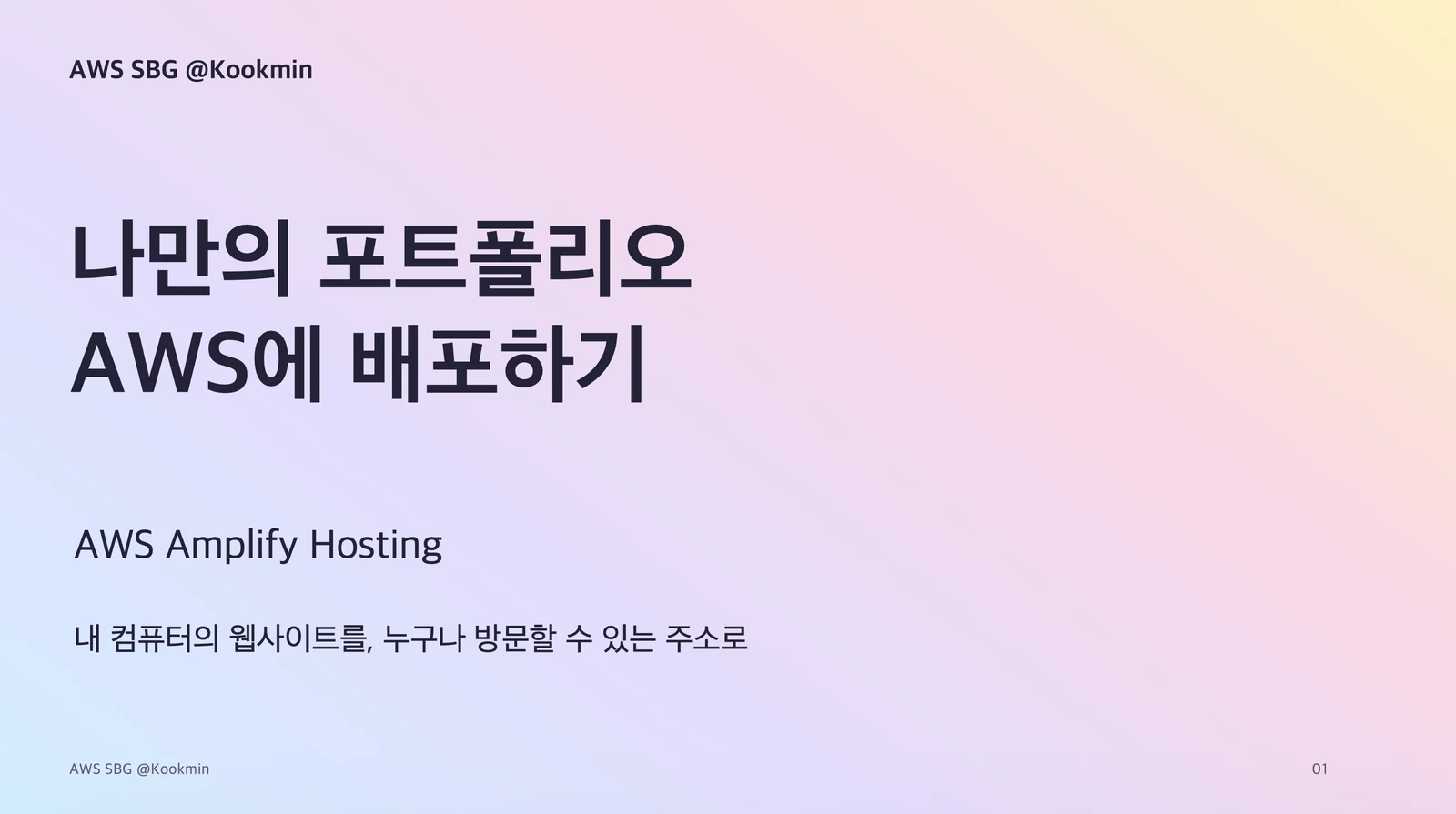
Deploy Your Own Portfolio with AWS Amplify
2nd Event · 10 November 2026 · 12:00 to 13:00 KST · Autonomous Driving Studio, Mirae Hall, Kookmin University · Bring your own laptop
The second event is a hands-on deployment session. Members take a ready-made portfolio template, make it their own with an introduction, projects, and activity history, then publish it to the web with AWS Amplify Hosting. In one hour, a site that only lived on a laptop becomes a link anyone can visit.
- 01
Make it yours
Fill the portfolio template with your own introduction, projects, and activity history, so the site tells your story rather than the template's.
- 02
Meet Amplify Hosting
See how AWS Amplify Hosting takes a site from your code and serves it on the web, without setting up a server yourself.
- 03
Ship and share
Deploy the portfolio and leave with a live link you can put on a resume, a profile, or a message.
- 04
Keep costs in check
Check your AWS Free Tier benefits and learn how to clean up deployments you no longer use once the session ends.
Made for anyone who wants a portfolio website of their own, wants to introduce their projects with a single link, or wants to try a real cloud deployment for the first time. Bring a laptop and charger, a fresh email address for a new AWS account, and the introduction, project details, and images you want on your portfolio.
Charges may apply depending on your AWS account's Free Tier eligibility, credit balance, and usage. The session covers how to check your free benefits and remove deployments you no longer need.
First group eventCloud Escape: Project ECLIPSE
1st Event · 29 October 2026 · 18:00 to 20:00 KST · Mirae Hall, Kookmin University · Teams of 3 to 4
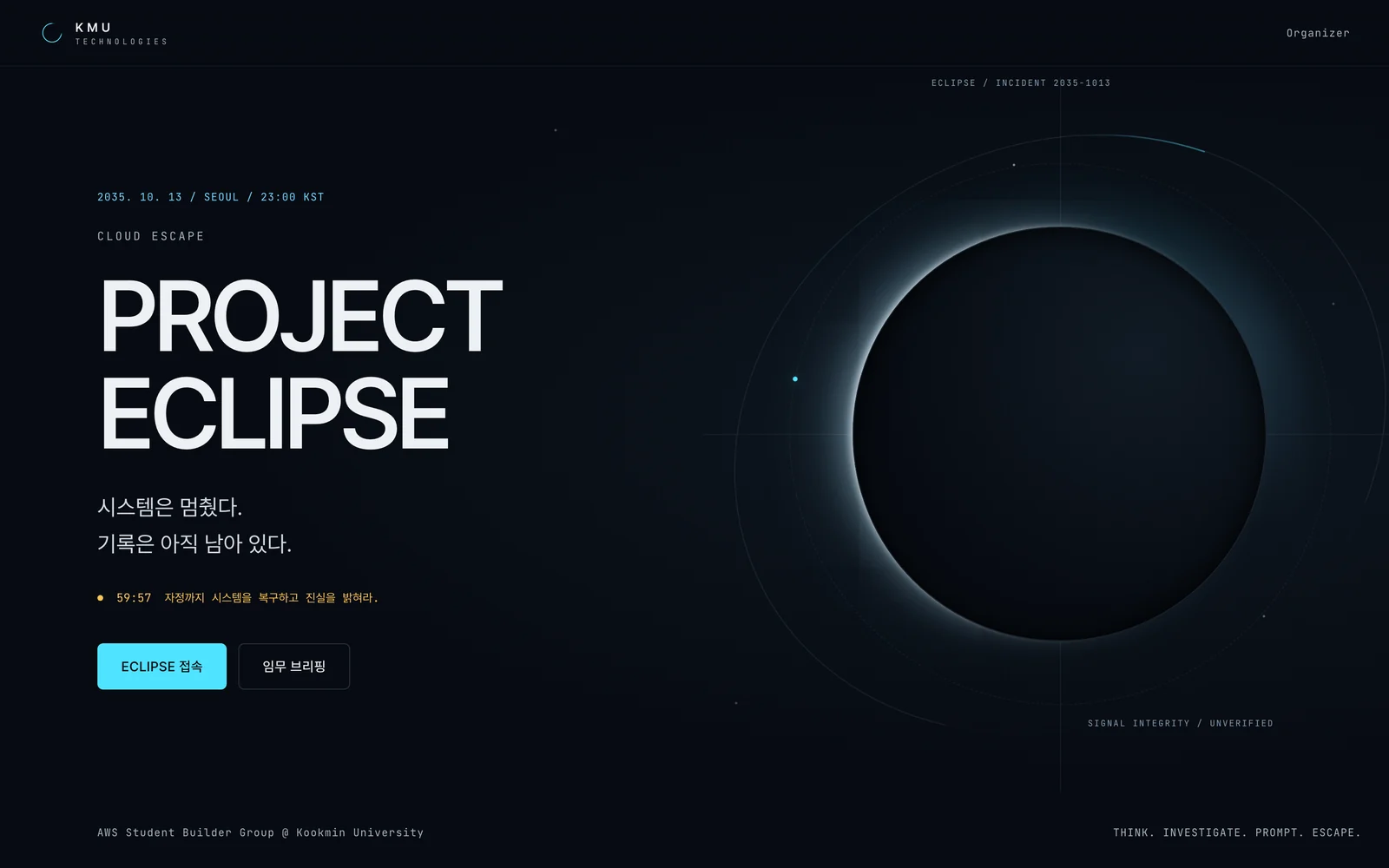
Cloud Escape: Project ECLIPSE
1st Event · 29 October 2026 · 18:00 to 20:00 KST · Mirae Hall, Kookmin University · Teams of 3 to 4
The group opened with a cloud forensics escape room rather than a lecture. The setting is Seoul in 2035, where KMU Technologies' research platform ECLIPSE went dark at 22:15 with no warning. The database refuses authentication, the research archive looks empty, and the incident report blames an outside intruder, except nobody can say who wrote the report. At midnight the archive seals itself automatically. Sixty minutes on the clock, four stages, one final deduction, and three possible endings depending on what a team concludes.
- 01
Scrambled logs
UTC, epoch, and KST. The same moment wears three different faces, so recovering the real order of events is itself the first piece of detective work.
- 02
Ghost account
Someone who left three months ago signs in tonight. An account records a name; it never records the hands that typed.
- 03
Hidden archive
Four fragments scattered among more than a hundred storage objects, where something deleted and something moved are not the same thing.
- 04
Architecture recovery
Route 53 through to RDS. Teams drag the broken diagram back into shape and reconnect it to bring ECLIPSE online.
Teams of three or four work from their own laptops, and one nominated controller locks in the final deduction. AWS Kiro sits alongside as an AI investigation partner that reads the evidence files and answers questions, which leaves players to separate what the AI guessed from what the logs actually recorded. No coding required: a little AWS familiarity, careful reading, and a willingness to keep doubting the evidence is enough.
KMU Technologies, ECLIPSE, and every character, log, account, and incident in the game are fiction written for the event. Nothing is connected to real AWS resources or credentials, and AWS service names appear for teaching purposes only.